Showing posts with label students. Show all posts

Friday, 25 January 2013

Dear Sir Minister Cameron.....


It’s been one of my various jobs, over the past ten years, to teach English as a Foreign Language at a local college, not far from N-o-T.

When I first began, the Government of the Day, in its wisdom, had decreed that EU nationals, asylum seekers and those in receipt of benefits could avail themselves of free English lessons. It was also a time which hailed the start of an impressive influx of people from Poland into the UK. I had started teaching in February, and the following September, at the start of the academic year, my new class numbered some 48 students, of which 60% were Polish. Not so much teaching as crowd control! A number of additional teachers were swiftly recruited, as lessons had turned into a huge game of musical chairs as the number of students increased exponentially week-on-week, whilst the number of chairs and table remained at the same level.

Now, some ten years on, many of the Polish students I knew in those days have returned to Poland, although I still bump into a few from the early days, very settled in the local area.

My classes today are a much more multinational affair. This term, I have 14 students (the numbers now are much more manageable, and have been since the Government stopped free lessons: they were “too successful”). The mix of nationalities mirrors much of what we hear in the media. Of my 14 souls, four are Spanish, two Greek, two Portuguese, one Russian, one Pole, one Slovak, two Indians and a Colombian. The last two years have seen a significant increase in the numbers of students from southern Europe, whilst there are very few Poles these days.

In my local area, which may not be representative of the demographic elsewhere, most of these people are either au pairs, or work in catering and hospitality. A surprisingly large number also work as carers for the elderly or in care homes. I read (when I can’t avoid it) with some confusion and dismay the reports of immigrants being in receipt of benefits, housing, handouts and support, and wonder where these people live. Because I’ve never met any migrants who conform to that profile. 

Not only do they all work, but they give up 5 hours a week after work to attend English lessons. And they work hard at that, too. They attend regularly, they ask for the work they’ve missed if they can’t come, they do homework and they work their socks off in class.  And they pay for the privilege.
Last week, we had a lesson about the EU, the UK and the latter’s current approach (or that of the current Government of the Day) to the former. Mr Cameron’s current pronouncements on the EU and immigration have most of them flummoxed. 

“So”, they asked “if we go home, will English people want to do our jobs?”

“I have never seen an English person apply for a job where I work” said one “until this year. This year we took on three English people. They lasted just 3 weeks”

“ We pay tax and National Insurance” they said “And we don’t use the NHS”

“I expected to come here and be a waitress” said one Spanish girl – she and her partner are in my class “but we both found jobs in IT, which is what we’re qualified in, and they were really pleased to have us”

“ We are contributing to the cultural mix in the UK” they said “And it’s what we love about being here: the diversity”

So I asked them, for homework, to write a letter to Mr Cameron, telling him how they felt and what they thought.

All of them did a great job. They expressed themselves, within the limitations of their command of English, with eloquence and clarity.  At a time when I’ve been questioning whether I want to continue doing this job at all, they made me remember why I love it.

Here’s a letter from a lady who is a grandmother, and whose grandchildren and children are back in Poland. I’d like David Cameron AND Nigel Farage to read lots more letters like this:

Dear Sir Minster Cameron (OK, a bit of work to do here…)
I writing to you, a Polish immigrant, living alone in the UK almost 7 years.

Last time you said that “Migrant jobseekers who don’t bother to learn English will be stripped of benefits”

So I’m learning English, I’m watching only English TV and I’m reading newspapers every day.
I’m working all the time and don’t use the benefits. I’m working in English company, I have a contract for work. My employers are happy of me because I respect my work and carry out their/my diutes well. All this time I pay tax and insurance.

I have many of English Friends at work. We often meet after work. We cook together and talk about English and Polish culture, history, music and literature.

Sometimes we go out to a restaurant, to the cinema or a pup.

I live in this country, sought to make something good for him..And therefore I don’t understand why you don’t like Polish immigrants.

Sometimes, when I’m out and about in Nowhere-in-France, I have the misfortune to come across people, British people, who wax lyrical about “(*)(*^&%^! Immigrants  in the UK” and how it’s “one of the reasons we left”

For me, they’re one of the reasons I stay. And why I don’t think there’s anywhere else I’d rather be. Unless some idiot in Westminster decides to spoil it all.

Wednesday, 7 March 2012

I love my job..


A couple of weeks ago, I was asked to take on a new class at a local children’s centre attached to a school. It was billed as a “Communication Skills” class, and I was told that there would be seven or eight students with a similar level of English.

I’m about to embark on week three. Week one wasn’t too bad. One lady was clearly more advanced than the others: I did a class on parts of the body and visiting the doctor, and at the end I found out that back in her own country (Japan) she’s a nurse.. Oops! The three Polish students can speak a little but write next to nothing. This was demonstrated when, on filling in their registration forms, all three ticked their ethnic origin as being “White Irish”. The Romanian lady understands some things, but can’t write either, so I had to fill in her form. I spent a good five minutes trying to extract her date of birth from her, including miming rocking a baby and singing “Happy Birthday to you” whilst she shuffled through her purse, bringing out her National Insurance card (no birthdate) and a handful of supermarket receipts (ditto). We got there in the end, but I was beginning to see the magnitude of the task ahead.

Week two was a surprise. Half the students seemed to have decided to bring a friend, so my seven had grown to eleven, of whom three spoke not a word of English. Now things got difficult. If I gave the more advanced ones something to do, the non-English-speakers sat silently looking lost, and if I spent time with the beginners, the more advanced group had finished their work and were discussing other things.  The Polish and Bangladeshi contingents help each other, so that works. The Romanian lady brought her friend, so they can at least sit together for moral support. The Hungarian lady went rigid with fear every time I looked her way. The Venezuelan lady, who came with her husband (he speaks English so he went home), sat looking petrified and then gave me a bear hug at the end and said “Thank you”..although I’m not quite sure what I did!

They can all introduce themselves, so that was a start. By dint of struggle, I’ve learned that between them they have 26 children, all or most of whom were born in the UK, and many of whom must therefore speak English, but that hasn’t helped their parents.  They’re all really lovely people and anxious to learn, so the onus is on me to deliver, but this one’s a real challenge.

It’s only two hours, but if anyone’s driving around the Surrey/Berkshire borders tomorrow at about lunchtime and sees a woman in a little car, gripping the steering wheel with a glazed expression and with her hair sticking out all over the place, don’t worry. It will mean I’ve survived another week.

Friday, 20 January 2012

"My head is full of porridge"


This is my new favourite expression, courtesy of a lovely Russian lady I’m teaching at the moment. She had been doing some homework to practise using “Needn’t, shouldn’t, mustn’t and don’t have to” and found it all a bit confusing.   

My students’ efforts with the English language are often a source of great entertainment, and I thought I’d share one or two of their better efforts with you. I'm laughing with them, not at them, and I'm not telling you anything behind their backs that we haven't already giggled over together in class or outside.


One of the first examples came several years ago when I was doing a lesson with a class about letters to agony aunts. They first had to understand the concept, so I asked them what an agony aunt was.
Silence
Me: “OK...you all know what “aunt” means, don’t you?”
Class: “Yes”
Me:” So does anyone know the meaning of ‘agony?’”
Chinese student:  “Yes....it’s when you are a teenager and you get spots all over your face”
Me: (Trying not to be too discouraging) “Well, not quite....you’re thinking of acne”


More recently, there have been a couple of really brilliant mistakes. The first of these comes courtesy of Maria.

Maria is Sicilian. She’s lived in the UK for many years. Her accent remains almost impenetrable, probably not helped by the fact that her husband is Ukranian, but she arrived in my class determined to improve her English and with it her job prospects. At the time, I had another Italian girl in my class, who confided to me after a couple of lessons that even she couldn’t understand Maria. Of greater concern was that not only couldn’t she understand Maria when she spoke English, she couldn’t understand Maria’s Italian either!  It transpired that Maria’s contributions to the class were largely only intelligible to her and me.

I’ve been teaching advanced-level students for a while now, and one of the things I feel is important  to cover is swearing and profanity. By this stage, they’ve all come into contact with bad language, but the subtleties of this vocabulary, whether and when it’s appropriate, and just what some of it means, can remain a mystery unless tackled and explained in a safe environment. So I have a lesson dedicated to swearwords.

All went well with the class. As usual, there was a bit of embarrassment at the start when I asked them to come to the board and write all the swearwords they could think of, but once they got over that, they set to with gusto and surprised me with the breadth of their knowledge. Maria wasn’t contributing a lot, but, as she explained, being a good Catholic lady, she hardly ever swears, either in Italian or English, so she didn’t know many swearwords. No problem so far. So we moved on to swearwords featuring body parts. I gave the students a handout with various examples of swearwords and the corresponding body parts and bodily functions to which they referred, and stepped back to let them match up the two. When everyone was working away, I walked around the room to check how they were doing. Maria was stuck, so I asked if she needed any help.

“What’s this?” She said “I don’t know this word. What does it mean?”
The word was “prick”. So I explained: “It’s a penis, Maria”
“Oh, right, I see. Like the flower”
“No, Maria. We don’t have a flower called a ‘penis’”
“Yes, you do. My neighbour had some in her garden, and I asked her what they were, and she said it’s a penis. So I went to the garden centre and asked if they had penis and I bought some”
“Maria, really, we don’t have................do you mean PEONIES???”
“Yes, that’s it! Penis”


And finally...this one’s courtesy of a friend, but reader, I was there...
In a previous job, I was responsible for organising language classes in my company. We had loads of French interns who came for a year or so and were mostly already proficient in English, albeit with rather splendid French accents that they couldn’t quite shake. We had to stop the MD from making speeches where he (speaking on behalf of the Board of Directors) would announce “We would like you all to FOCUS” because his accent gave the word a whole new meaning that he certainly didn’t intend.

And so it was that I was approached by one of the interns who asked, on behalf of the group, whether it might be possible for them to have some English lessons to help them with their pronunciation. We organised some classes in the lunch break, and all went well. Until the day that my language training supplier, who was running the classes, came into my office giggling like a schoolboy and shut the door behind him.
“You’ll never believe this” he snorted “but I have to tell you”

Anyone reading this who listens to a French person speaking English will be familiar with the problem of pronouncing words with the long vowel sounds. A French person has real difficulty making the difference between words like “this” and “these” or “heat” and “hit”. If you haven’t come across it, then just remember that a French person will say “it” when they mean “eat”. Which was the problem that the students wanted to address. Using your French pronunciation skills, read on:

Student 1 :“I have a problem in my department. Every time I ask for a piece of paper, everyone laughs at me”
Tutor: “Ah yes, well that’s because......”
Student 2 (interrupting): “I think I have solved the problem”
Tutor: “OK, tell us how?”
Student 2: “I no longer ask for a piece of paper..I ask for a sheet of paper!”


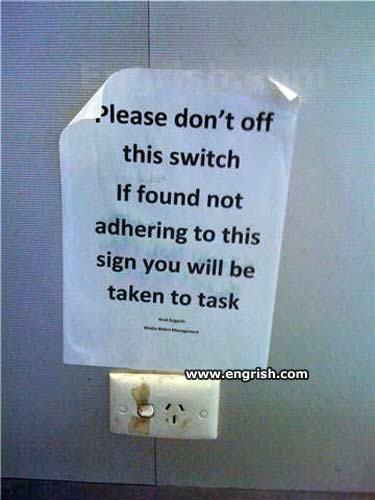
Images courtesy of engrish.com. If you've never visited, check it out!